

Everything Christian came from old Greek, then they spoil. All, all comes from Greek. Even from before time when was Bible. Your Bible is new book.
— G. I. Gurdjieff
A
teacher-magician appeared in Hellenic Greece who brought a message of awakening to attain individual integration through the soul. Born in the mid-6th century BC (c. 566–490 BC ), his name is already familiar to us. In fact, in geometry class we may have had the task of writing the mathematical proof he is known for, but like everything we’ve “learned” the depth of what he brought remains largely obscure. This rare being was Pythagoras and his teaching was to learn, understand and integrate the divine principles of the universe that exist and govern each of us. Through the lens of the seeds he planted in his early disciples, particularly Empedocles, we hear a Western teaching deeply rooted in and embracing the physicality of the body and the greater world as the means towards a Divine Harmony. For Pythagoras, the disciplines of science, number, sound and music were not intellectual exercises; they were not separate. Rather they were given within the context of the Sacred because their purpose was to reveal the One and our relative place and purpose within it.Pythagoras is among the few known Teachers given specific mention in Mr. Gurdjieff’s First Series, Beelzebub’s Tales to His Grandson. And he tells us that Pythagoras was a key being in organizing the various methods and vehicles for the transmission of genuine knowledge, which at the time he existed, due to the continual destruction through wars, was in danger of being lost forever. It was a crucial moment—to ensure the preservation and lineage of this knowledge that it might survive for subsequent generations. His legacy to us reverberates in the West in ways that we have yet to discover.
How might Pythagoras, this Hellenic Greek, be connected with the essence of the teaching Gurdjieff brought and which he called The Fourth Way? Every spiritual Messenger, Prophet, Teacher is bound to and bound within a lineage of Great Knowledge, which is, Gurdjieff says, “handed on in succession from age to age, from people to people, from race to race. The great centers of initiation in India, Assyria, Egypt, Greece, illumine the world with a bright light.”
We know Gurdjieff held that the expression of the Great Knowledge he brought is in essence, as he said, “esoteric Christianity.” But to leave it there would be neither accurate nor complete, because he was also clear in discriminating exactly what true Christianity refers to. He was speaking about specific principles and ideas that were already established and practiced in pre-historic Egypt, that is, an Egypt that existed thousands of years before the birth of Christ. In fact, the Christian church and its form of worship didn’t originate from the Church Fathers, he says, but “was all taken in a ready-made form from Egypt.”
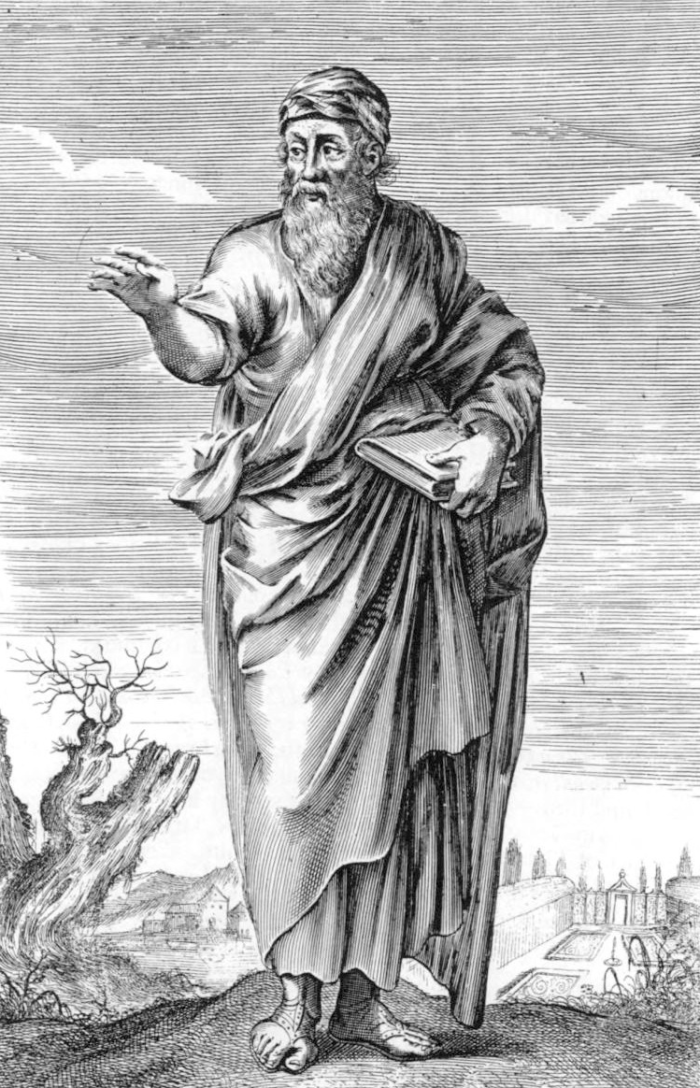
Pythagoras, ancient Greek philosopher as imagined in Thomas Stanley’s (1655) The history of philosophy: containing the lives, opinions, actions and Discourses of the Philosophers of every Sect
So how to reconcile Gurdjieff’s statements about a Christian pre-historic Egypt and the opening quote, “Everything Christian came from old Greek. . . . All, all comes from Greek. . . . ”? Why also would he say, “There are three kinds of onanism. The Greeks called them onanism, Platoism and Socratism. . . . Each center has its own onanism.” Being a philologist of the first order, for Gurdjieff to place the word-names Plato and Socrates in this context is significant. While appearing as a passing mention, in actuality it is issuing a kind of warning that to get to the kernel of what they taught we should be very aware of what else surrounds it. Could it be that the “old Greek” he is referring to is precisely Pythagoras and the heredity he represents—who, though his school was established in Magna Graecia, the Greek colonies in southern Italy, had himself passed through just those centers which Gurdjieff called “great centers of initiation”?
Shining a Light on Pythagoras
In his First Series, Gurdjieff introduces Pythagoras by relating that Beelzebub first met him on the continent of Asia when Beelzebub descended to Babylon, which at that time was considered to be the cultural center of the Earth. This Babylon that Beelzebub found was one in which the beings living there were greatly degenerated in their psyche. That is, the instinctive functioning for the genuine impulses of Faith, Hope and Love were no longer present in a normal sense.
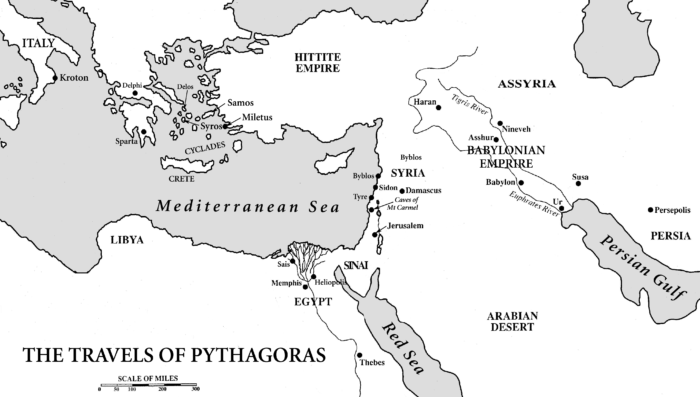
This fortuitous meeting between Beelzebub and Pythagoras occurred only because Pythagoras, after his long stay in Egypt, had been taken captive and brought to Babylon by the Persian King Cambyses II in 525 BC. It was a time of “gold fever” in Persia and Cambyses II had been searching for the secret of the new alchemy invented some centuries earlier by an individual named Harnahoom concerning turning any metal into gold. Convinced that Persia did not hold this secret, Cambyses II sent special hordes to Egypt, because it was known that knowledge of all the sciences was concentrated there among the native Egyptians and others who had gone there from all the continents of the planet.
But soon after taking Pythagoras and others into captivity, Cambyses II’s gold fever had waned and, having turned his attention to the conquests of neighboring lands, the former captives began to live freely in Babylon. So, in the course of meetings and discussions among themselves a burning question arose: Do men have souls? This question attracted not only those beings brought there by coercion but also others who had gone there voluntarily due to this very question. These discussions resulted in the “Building-of-the-Tower-of-Babel.” That is, two theories wiseacred from the Reason of the subjective psyche—a dualistic theory of immortality with the existence of the soul and a second atheistic theory expounding the opposite of the first. And so, it was within this heightened context of wars, conquests and captivity on the one hand, and the question of the soul on the other, that Pythagoras and Beelzebub met.
Most of those in Babylon who were considered highly learned were, as Gurdjieff calls them, of new formation. That is, they learned mechanically by rote, never verifying or sensing material. These individuals eventually formed a central club in Babylon and it became so popular that when the city was divided into sections, each had its independent club.
However, there were other beings there, which, as Gurdjieff says, were genuinely learned and who kept themselves apart, in the suburbs of Babylon. These were beings who worked on their duty obligation to perfect themselves and so were able to sense cosmic truths corresponding to their stage of perfection. Among these genuine types were Pythagoras, Egyptian initiates and priests. The latter were descendants of the members of the Society Akhaldan who had existed on the continent Atlantis and, having escaped the catastrophe of its sinking, were the first to arrive and populate the Egypt that existed before the one we know. This Society, Gurdjieff tells us, was composed of genuinely learned members who through understanding of their duty for conscious labors and intentional suffering had attained a high degree of Being.
It was the members of this Society Akhaldan who were the seminal source, carrying and planting in pre-historic Egypt the principles and ideas of this Christianity before Christ, to which Gurdjieff points and to which he is indelibly linked. Having spent 22 years in Egypt prior to his captivity in Babylon, Pythagoras had been initiated into the Egyptian Mysteries by the very descendants of these Akhaldans, these earliest of Christians, arriving in Egypt from Atlantis.
Link to the Pythian Apollo
Indeed, no one can doubt that the soul of Pythagoras was sent to mankind from the empire of Apollo, either being an attendant on the God, or co-arranged with him in some other more familiar way: for this may be inferred both from his birth, and the all-various wisdom of his soul.
— Iamblichus
Pythagoras left no writings attributed directly to him. The Golden Verses of Pythagoras is thought to have been the work of Lysis of Taras (c. 5th century BC) who was his friend and disciple. While there are a few references to him by Xenophanes (570–475 BC), Heraclitus (535–475 BC), Herodotus (484–425 BC), Plato (428–328 BC), Aristotle (384–322 BC), Isocrates (436–338 BC) and others, the sources for biographical details depend on the writings of Diogenes Laërtius (c. 3rd century AD), Porphyry (234–305 AD), and Iamblichus (245–325 AD). It is said that Aristotle had written a separate work on the Pythagoreans, which unfortunately did not survive. Although, perhaps it was fortunate, because by the time of Aristotle, who was a student of the Plato Academy and the tutor of Alexander the Great, the Athenian milieu of progressive dissection of ideas seems to have moved farther away from the context of wholeness and the Sacred.
Although the exact date varies in the writings, Pythagoras is said to have been born about 566 BC in Sidon, a Phoenician city located on the Mediterranean Sea of modern-day Lebanon near the environs of Beirut. His father, Mnesarchus, was a descendant of Ancæus, who had been ordered by the Pythian oracle to colonize the island of Phyllas, now known as Samos. When Mnesarchus, a gem cutter, consulted the same Pythian oracle, who was the priestess at the Temple of Apollo in Delphi, regarding his voyage to Syria, he was told that yes, it would be a lucrative trip but that his wife Parthenis was now pregnant and would give birth to “a son surpassing in beauty and wisdom all that ever lived, and who would be of the greatest advantage to the human race in every thing pertaining to the life of man.” In honor of the Pythian Apollo at Delphi, Mnesarchus named his wife Pythaïs and his son Pythagoras, signifying that this birth was predicted to him by the Pythian Apollo.
Having returned to Samos with much wealth from his trip to Syria, Mnesarchus built a temple honoring Apollo and ensured that Pythagoras was rightly educated by the teachers of various disciplines, including all those whose wisdom was of the sacred.The young boy so impressed all those around him by the inner quality of his being that his mere presence commanded the attention of others. Though still young at the death of his father, his manner, says Iamblichus, was that “In all his words and actions, he discovered an inimitable quiet and serenity, not being subdued at any time by anger, or laughter, or emulation, or contention, or any other perturbation or precipitation of conduct; but he dwelt at Samos like some beneficent dæmon.” (The original meaning of the word dæmon is a god, whereas this meaning later devolved to the word demon.) He was revered and celebrated as the “long-haired Samian . . . by the multitude as one under the influence of divine inspiration.” This reference to long hair indicated Pythagoras’ homage to his Phoenician ancestry.
Received by the Sages
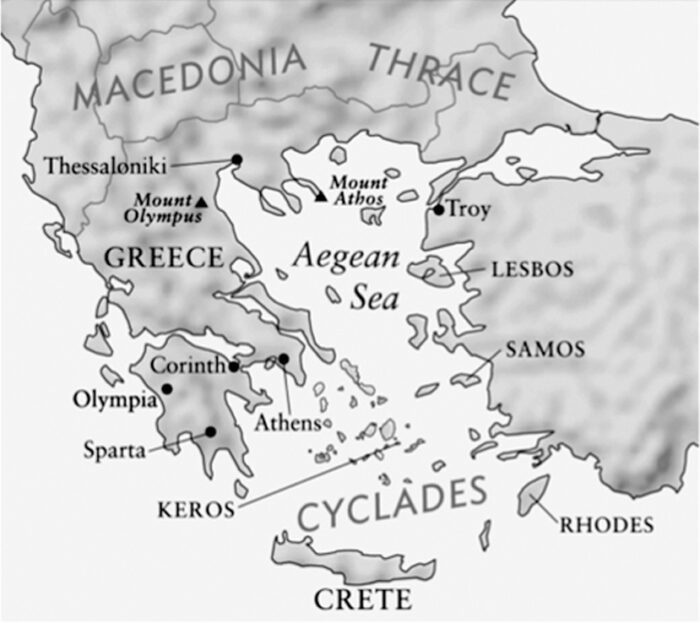
From Samos Pythagoras would eventually sail to the banks of central coastal Anatolia in present-day Turkey where he would study with Anaximander, the natural philosopher, and with his teacher Thales, regarded as one of the Seven Sages of Greece. But upon leaving Samos he sailed first to the island of Syros belonging to the Cyclades, a Greek island group in the Aegean Sea at whose center lies the island of Delos, considered a holy sanctuary and birthplace of Apollo and Artemis. In Syros he sought Pherecydes, sometimes referred to as the theologian, who is said to have learned from his travels in India and Chaldea and to have lived in Egypt. He is also said to have been the disciple of initiated priests of both Chaldea and Egypt.
In the presence of Pherecydes, Pythagoras likely first heard the teachings of the potential immortality of the soul and the principle of metempsychosis, the idea that the immortal human soul passes at the point of death of the flesh from one bodily form to the next. And he would likely have been instructed in the ideas contained in Pherecydes’ book Heptamychos (Seven-Chambered Cosmos), whose foundation held that there is a sacred trinity of Zas, Chthonie and Chronos that has existed forever. Zas being Zeus representing Ether, the active principle; Chthonie, the essence of Earth, the passive principle; and Chronos, Time, that in which all is produced. To Pherecydes these were eternal forces, always at work in creating the world.
From Syros, Pythagoras sailed to Miletus, a major seaport in modern-day Turkey just south of Ephesus, where he then sought out the teacher Anaximander. Known as a natural philosopher, he was the first astronomer to render a map of the world. From him, Pythagoras would have heard the idea that the first principle is not water or any of the elements but the Apeiron, that is, the Indeterminate, Limitless, the Boundless. Anaximander maintained that the first principle had to be prior to any of the elements—a source for all the elements and which itself has no source. Anaximander likely learned the idea of Apeiron from his own teacher Thales, the sage, also living in Miletus. Thales is credited with the aphorism, “What is the divine? That which has no origin and no end.”
Studying with Thales as well, Pythagoras would have been introduced to the idea that the origin of all matter is water. Thales had studied in the temples of the Aegean Sea, Babylon and Egypt where he learned mathematics, astronomy and geometry. He was able to calculate the height of the pyramids and was the first to predict the eclipse of 585 BC. Shifting away from explaining the world of phenomena through the use of mythology or theology, Thales is said to have been the first to use the scientific method of deduction to explain natural phenomena.
Immediately recognizing the exceptional qualities of Pythagoras, Thales brought him into his inner circle and began to impart to him all that he possessed. But Thales, who was by this time at the end of his life and in failing health, urged Pythagoras to sail to Egypt, to gain entrance to the temples and seek to become an Egyptian Initiate. Thales could foresee that this youth would master the teachings of Egypt and he would, due to his already divine qualities, soon surpass not only Thales himself but all who came before him in divinity and wisdom.
Thales counseled him on the importance of Time. This idea impressed Pythagoras to the extent that he made a plan for his life concerning the body. He began to understand that in order to make use of one’s time for learning and mastering higher levels of divine qualities, the body had to work properly and efficiently, which would then allow one’s energies to be devoted toward one’s highest aim. To that aim, he abstained from “wine and flesh,” eating instead foods that were light and easy to digest. Applying this practice allowed a certain alertness, clarity of mind and a harmonious functioning of the body.
The Road to Egypt
Pythagoras then sailed from Miletus to Sidon, his birthplace. From Sidon, it would be a direct passage into Egypt. However, once in the environs of Phoenicia it is interesting that he didn’t go straight to Egypt but instead stayed there for approximately three years, where he was initiated into all the mysteries of the Phoenicians in the temples of Tyre, Sidon and Byblos, which he learned “were derived like a colony and a progeny from the sacred rites in Egypt.” In fact, the link between Phoenicia and Egypt is so strong that the ancient myth concerning Isis, Osiris and Horus includes Isis making a trip to Byblos to retrieve the body of Osiris which had washed up on its shores.
While in Phoenicia, Pythagoras lived mostly in the environs of the Gulf of Haifa in the secluded caves of Mount Carmel, which at that time was a center for ascetic life and which Iamblichus says was “more sacred than other mountains and inaccessible to the vulgar.” Some believe Mount Carmel was the main temple school of the Nazorean Essenes. Interestingly, there were many similarities between the structure and teachings of the ancient Essene community and what we know of Pythagoras’ school founded late in his life in Kroton, Italy.
Everywhere Pythagoras went he never failed to make contact with all the prophets and Phoenician hierophants. His was an unquenchable thirst to learn, not allowing anything to escape him concerning the mysteries of the gods. When he was ready to sail to Egypt, there had landed on the shores of Mount Carmel an Egyptian boat. The sailors gladly received him and planned on making a profit by selling him to the slave trade. However, during the voyage they perceived something magnificent and benevolent about his presence and recalled how they had watched him descend down the mountain with ease, grace and without delay despite the precipices and obstacles of the mountain. It was as if he had floated down the mountain.
During the voyage they observed his silence and unperturbed demeanor as he sat for three days and two nights, without taking food or drink. The tranquility of the voyage and their impression of Pythagoras convinced the sailors that they had in fact been accompanied by a divine dæmon on their passage from Phoenicia to Egypt. Upon arriving they reverently assisted him onto land where they erected a temporary altar for him and provided him with many fruits to regain his strength from the fast.
Egyptian Initiate
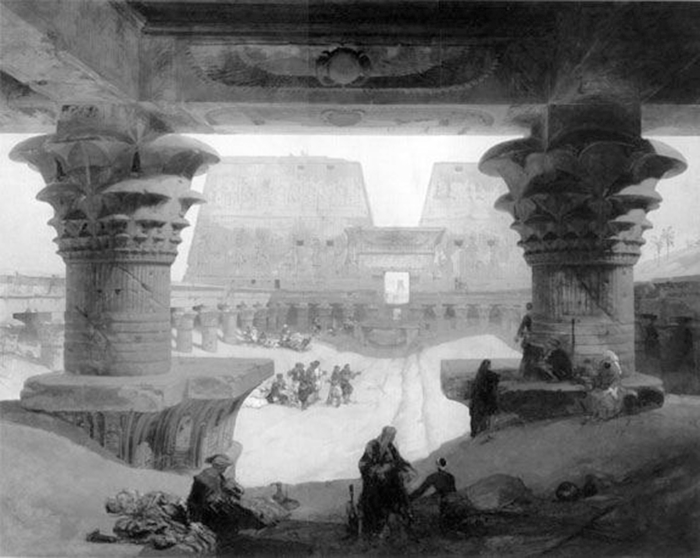
Arriving in Egypt about 547 BC, Pythagoras was to experience the end period of the 26th Dynasty (664–525 BC) — the last native dynasty to rule Egypt before the Persian conquest in 525 BC. Having a letter of introduction from Polycrates, Samos’ ruler, Pythagoras first visited the Pharaoh Amasis II at Sais, the ancient Egyptian capital located in the Western Nile Delta. Amasis II, who had been indebted to Polycrates, was a great admirer of Greek culture and had made various gifts to Hellenic temples, including the temple of Apollo at Delphi. Impressed by the countenance of Pythagoras, the pharaoh provided him with official documents necessary to gain admittance to the temple schools, which at that time were concentrated and preserved in Heliopolis, Memphis and Diospolis (ancient Thebes).
But possessing official orders from the pharaoh himself was not enough. Pythagoras found himself being sent from one temple to another under the pretext that they could not impart the most esoteric teachings and that he should keep traveling to the next temple school known to possess what he searched for. Finally arriving at Thebes, the temple priests admitted Pythagoras but not before first subjecting him to the most arduous of tests. They prescribed for him harsh disciplines with regard to service, study, fasting and other ascetic hardships, expecting Pythagoras would soon succumb to his lower nature and leave the temple. However, nothing of the sort occurred, because Pythagoras not only performed all that was demanded but did so with such intensity and exactness that the priests understood this neophyte was of a different caliber, readily earning their respect.
The Theban priests initiated Pythagoras and asked him to live in their temple among them. Not even Thales, whose knowledge and wisdom originated from his studies in Egypt, had gained entry as Pythagoras had done. Iamblichus states that Pythagoras was admitted to the adyta of Egyptian temples, that is, the innermost sanctuaries of the ancient temples where the most esoteric of mysteries were taught, accessible only to the high priest and his initiates.
During the 22 years Pythagoras lived in Egypt he made contact with all the oral teachings, priests and ceremonies of the time, all the while absorbing and integrating what he learned into his being. Iamblichus tells us that Pythagoras “was both admired and loved by all the priests and prophets with whom he associated.” He was fluent in the wisdom of Egyptians and learned their three languages — epistolic, hieroglyphic and symbolic. The instruction he received spanned all sciences, among which were mathematics, medicine, herbalism, music, architecture and the sacred science of the soul, the central theme around which the school he would found in his later life would revolve. In Egypt, Iamblichus tells us, Pythagoras “was initiated, not in a superficial or casual manner, in all the mysteries of the Gods . . . . ”
How might we glimpse what those “mysteries of the Gods” refers to? For this we must turn to R.A. Schwaller de Lubicz, the modern alchemist and Hermetic philosopher best known for his seminal exploration of ancient Egypt. Having lived and studied at the Temples of Thebes for 12 years, he tells us that at the Temple of Hermopolis is found the teaching that connected the three mysteries issuing from the temples at Heliopolis, Memphis and Thebes. These mysteries embody a myth that is not fiction or legend but is evoked through sacred writing—the hieroglyph—and that deals only with the sacred and divine principles of Nature. In these mystery centers there was a body of sacred living knowledge kept alive and passed from hierophant to initiate dependent on the initiate’s spiritual preparation allowing for divine revelation. Pythagoras would have been well versed in these ancient Egyptian mysteries and initiated into them.
Regarding these “mysteries of the Gods,” Schwaller de Lubicz says:
Revealed at Heliopolis is the creative act and the appearance of Tum (or Atum) as well as of the Ogdoad, which is the analysis of that creative act.
Taught at Memphis is the work of Ptah, which is the giving of form and the animation of these forms.
At Thebes, the fruit of this genesis is defined through Amon, Mut, and Khonsu.
At Hermopolis, the milieu of generation is found described through Tehuti, or Thoth, connecting the three mysteries.
The teaching of these centers constitutes a whole that cannot be segmented; yet, through the universality of their respective mysteries the myth of each temple retains an aspect of totality.
The texts which speak of the mysteries pertaining to a particular center are concerned with the phases of the Neters’ becoming. This theogony, as it may well be called, has given rise to strange interpretations and assumptions, such as the belief, for instance, in theological rivalries. As far as the principles (or Neters) are concerned, they have been regarded as personalities that act with the free will of humans. In general, there has been a refusal to consider the differences characterizing these texts as being descriptive of the genesis which leads the principle of origin toward its manifestation…
Thus, three mysteries integrated in the fourth at Hermopolis. Quite significantly, Solita Solano, a member of Gurdjieff’s all-women’s group of the 1930s, wrote concerning Gurdjieff and Egypt, “He told us in the café he had been four times through the initiate mysteries of Egypt.” It seems no coincidence with the number four that Gurdjieff is pointing to having fulfilled and received the full initiatory requirement in Egypt from those same descendants of the Society Akhaldan, just as Pythagoras himself had done 2,500 years before.
Babylon & the Adherents-of-Legominism
In the 23rd year of his stay in Egypt, in 525 BC, Pythagoras, along with members of the Egyptian priesthood were taken captive by the Persian armies of Cambyses II to Babylon, the center of metropolitan culture in the whole of the earth, but also now a center of convergence of genuine learned beings from other parts of the Earth. Here Pythagoras would undoubtedly have taught, but he also continued to learn and perfect his self-knowledge and being. According to Porphyry and Iamblichus, in Egypt he mastered geometry and astronomy; in Babylon with the Chaldeans he perfected his knowledge of astrology, astronomy, the science of numbers; and with the Magi, who were Zoroastrian priests, he learned the rituals and purification ceremonies before the sacred fire of Ahura Mazda.
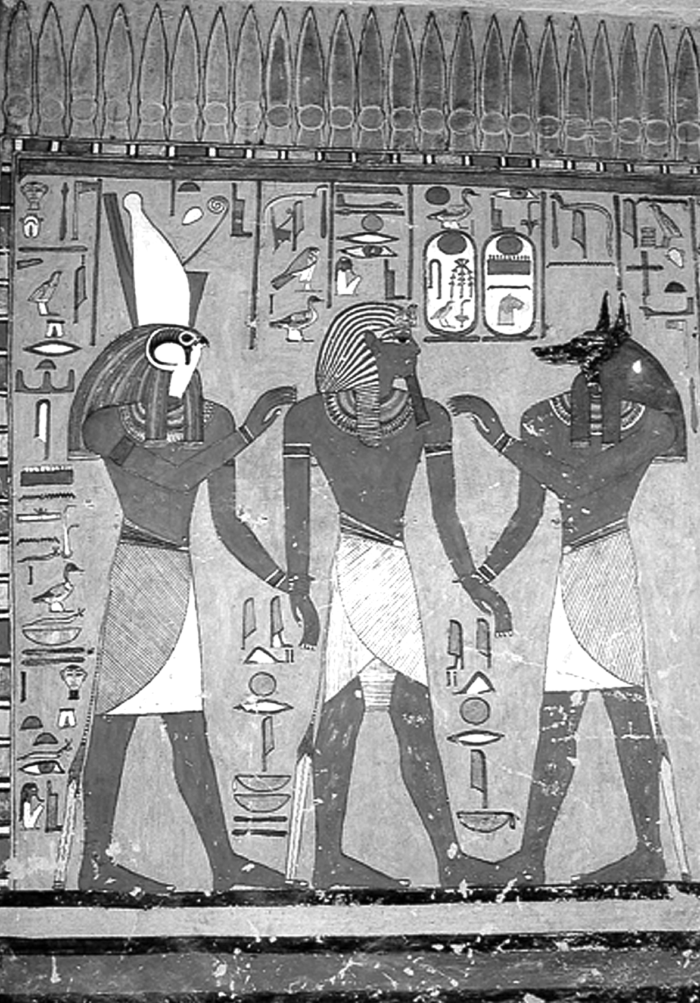
Yet, in no other writing, except in Gurdjieff’s All and Everything, is any reference or account given of Pythagoras’ influence while in Babylon as one of the founding members of the club of Adherents-of-Legominism where that fortuitous meeting between Beelzebub and Pythagoras occurred. Members of this club understood that Legominisms were the only means of transmitting genuine knowledge concerning factual events on the Earth from initiate to initiate.
This was an uncertain and crucial time in Babylon and elsewhere with numerous takeovers or, as Gurdjieff puts it, “reciprocal-destruction.” And, as Beelzebub relates, during this time the beings of the earth had an accelerated degeneration of their “psychic-organization.” Therefore, not long after arriving in Babylon, Pythagoras and another genuine learned-being, Kanil El-Norkel, a Moor, saw that in times of war the first to be sacrificed were these genuine initiates along with their Legominisms. Therefore, they foresaw the necessity of gathering together other genuinely learned beings in order to find a way of somehow preventing the destruction of Legominisms essential for future initiates of the Earth.
Together, Pythagoras and Kanil El-Norkel founded the club of Adherents-of-Legominism and the membership numbered 139 genuine learned beings, including Beelzebub himself. As Cambyses II had soon lost interest in his reason for taking so many beings captive, he freed them. And while the beings of “new formation” were building their Tower-of-Babel with the question of the soul, the members of this club discussed in their first meetings how upon returning home these learned beings would collect all the existing Legominisms in their countries, bring them back and make them available to all the members of the club to carry out their task.
It was during Beelzebub’s third attendance at the club when he heard the aged learned being, the Chaldean Aksharpanziar, address the members evoking the name of the Messenger from Above, the Very Saintly Ashiata Shiemash. This Chaldean told Pythagoras, Kanil El-Norkel, Beelzebub and the others that the form of Legominisms renewed by Ashiata Shiemash seven centuries earlier should be continued as a means of transmitting true knowledge. But because they had already seen how these same Legominisms had been destroyed, it was necessary to add some new means of transmitting true knowledge by making use of the existing experience of prior generations, as well as from the ways of contemporary life. In particular Aksharpanziar suggested the Legominisms could take the form of hand-made products of lasting materials, as well as through religious ceremonies, established customs, and religious and popular dances. Further, he said that the means of transmission should be through a fundamental Universal Law and the contents of the true knowledge would be placed in particular places according to this law. The whole of the production, he told them, would itself be like a Legominism.
Pythagoras, unanimously with all the other members, agreed and decided to follow the learned Chaldean’s suggestion. The result was that they applied the Universal Law in all their activities and dividing themselves into seven groups proceeded to produce these new types of Legominisms. Each day of the week was dedicated to exploring and producing different forms: 1) religious and civil ceremonies, 2) architecture, 3) painting, 4) religious and popular dances, 5) sculpture, 6) mysteries and theater, and 7) music and song.
And so, Pythagoras was a primary catalyst for this rare assemblage of genuine learned beings from various parts of the Earth responsible for establishing both the method and the forms that would preserve and ensure the transmission of the lineage of Great Knowledge Gurdjieff speaks about.
From Samos to Kroton
Following his 12-year stay in Babylon, Pythagoras first returned to Samos, his native land. Well received and recognizing the fullness of his being and eloquence, they invited him to address the Samian people and tell of his experiences since having left 34 years before. As Pythagoras addressed them, he was bringing to their land the depth of wisdom he had attained and began to teach them through the use of numbers, geometry, symbolic images and speech. But the Samian people could not follow this exposition, which to them seemed not only foreign but demanding. However, determined to attract those who would be receptive, he first found in the gymnasium Eratocles, a young man of exceptional talent and discipline who became his first student. Thereafter, another young athlete joined them, Eurymenes, who became an Olympic champion by following a training program devised by Pythagoras.
During this time, Pythagoras traveled to neighboring regions and was recognized as a famous philosopher, a word Pythagoras himself coined, meaning lover of wisdom rather than sage, a wise man. He went to Delos, where he worshipped at the bloodless altar of Apollo. From there he ventured to oracles of the Greek world, including Samothrace, Imbrus, Eleusis, Thebes and also Delphi where his own birth had been foretold. Here the priests told him that the worship of the Pythian Apollo had its roots on the island of Crete. He then set out for Crete where he was initiated into the cult of Morgos, known for their orgiastic musical ceremonies celebrating the birth and death of Zeus. His final visit was to Sparta where he studied the functions of law and government.
Upon returning to Samos from his Grecian travels, he established his first school, known as the Semicircle, and began to attract students from the whole of Greece. But the Samian people themselves had no real interest in his ideas and teaching. Instead, they were impressed only by his sense of fairness and objectivity and regarded him more as a resource for help with administration of the city’s internal affairs as well as foreign relations. Knowing that dealing with these ordinary demands from the Samian officials would prevent him from dedicating himself to the spreading of his teaching and establishing his school, he decided instead to leave.
He sailed to Kroton on the Ionian Sea, then a Greek colony part of Magna Graecia, now modern day Crotone in southern Italy. Kroton had been, and was still then, a flourishing trade center, where as a child he had accompanied his father on business trips. When he arrived, a large crowd had assembled to greet him. To the gathering, this now Egyptian initiate began to teach concerning the sacred pre-historic Christian principles and ideas—about the qualities of the soul, that all living beings are connected, and new perceptions regarding the gods and heavenly spheres. The impact was so great and the resonance so deep that two thousand men and women, along with their families, sought to become his students. It was this first gathering that would soon form the Pythagorean School, attracting others throughout the Mediterranean and beyond seeking his sacred teachings.
Pythagoras’ Golden Thigh
Arriving in Kroton and at once permitted entrance into the school, Abaris the Hyperborean, who was regarded as a priest of Apollo, recognized Pythagoras as the Hyperborean Apollo. On his long journey from Hyperborea, from the far reaches of northern Mongolia, Abaris carried an arrow as a talisman of Apollo protecting him from any difficulties that could befall him. This was not an ordinary arrow and to carry an arrow and then to give it was an ancient Mongolian custom indicating that Abaris himself was a representative enacting a gesture of unspoken understanding between him and Pythagoras. Deeper still, it signified a transfer of authority and an entrusting to Pythagoras. Iamblichus tells us that when Pythagoras received the arrow from Abaris, he was “neither being astonished at the novelty of the thing, nor asking the reason why it was given to him, but as if he was in reality a God himself, taking Abaris aside, he showed his golden thigh,” indicating that what Abaris recognized in him was in fact true.
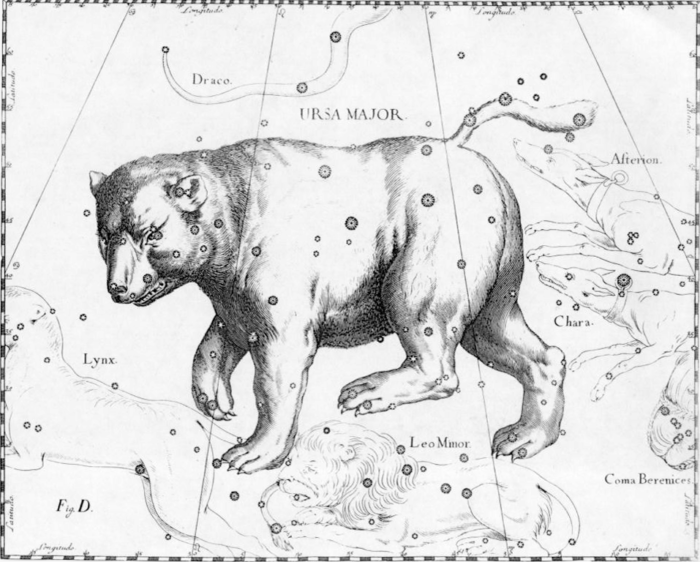
This gesture of Pythagoras to reveal his golden thigh resonates back to Egypt where in the temples of both Dendera and Edfu a single thigh or hind quarter of a bear is depicted as described in the Book of the Dead as “The constellation of the Thigh in the northern sky,” whose stars are part of what we now identify as the Ursa Major constellation. Inscriptions found on kings’ tombs and on the walls at Thebes designate the thigh as Set, the representative of the darkness and the divinities of evil. The hidden meaning of the femur bone is the place where the fixed salts of man through the process of alchemical transmutation are deposited and connected with the idea of rebirth. In effect, Pythagoras is revealing to Abaris, that, indeed he is the embodiment of the secret knowledge of turning base metals, Set, into gold. 
—Teresa Adams
To be continued
Notes
- “Everything Christian.” William Patrick Patterson, Ladies of the Rope (Fairfax, CA: Arete Communications, 1999), 128.
- “Handed on in succession.” G.I. Gurdjieff, Views from the Real World, 56.
- “Was all taken.” P.D. Ouspensky, In Search of the Miraculous, 2.
- “There are three kinds.” Patterson, Ladies, 97.
- Faith, Hope and Love. Gurdjieff, All and Everything, First Series, 321–22.
- Persian king. Gurdjieff, First Series, 455.
- Metal into ‘gold.’ Gurdjieff, First Series, 324–27.
- Do men have souls? Gurdjieff, First Series, 329–30.
- “Building-of-the-Tower-of-Babel.” Gurdjieff, First Series, 331.
- Mechanical learning. Gurdjieff, First Series, 323.
- These were beings who worked. Gurdjieff, First Series, 322.
- Arriving in Egypt from Atlantis. Gurdjieff, First Series, 301; see also Graham Hancock and Robert Bauval, The Message of The Sphinx (New York: Three Rivers Press, 1996), 199–201.
- “Indeed no one can doubt.” Iamblichus, Life of Pythagoras (London: J.M. Watkins, 1818), 4.
- Born in Sidon. Thomas Stanley, Pythagoras, His Life and Teachings (Lake Worth, FL: Ibis Press, 2010), 43.
- Pythia. In Wikipedia, http:// en.wikipedia.org/wiki/Pythia.
- “A son surpassing.” Iamblichus, 3.
- “In all his words.” Iamblichus, 5.
- “Long-haired Samian.” John Strohmeier and Peter Westbrook, Divine Harmony (Berkeley CA: Berkeley Hills Books, 1999), 25.
- Pherecydes. Strohmeier and Westbrook, 25, 143.
- Heptamychos. Kathleen Freeman, Ancilla to the Pre-Socratic Philosophers (Cambridge, MA: Harvard University Press, 1983), 13–14.
- Eternal forces. Strohmeier and Westbrook, 25.
- Anaximander. Iamblichus, 5–6.
- Apeiron. Crandall University, New Brunswick, Canada, http://www. mycrandall.ca/courses/grphil/ Anaximander.htm.
- “What is the Divine?” Dirk L. Couprie, Heaven and Earth in Ancient Greek Cosmology (New York: Springer, 2011), 91.
- All matter is water. John Miller, “Thales on Water: The Egyptian Connection,” Southwest Philosophical Studies (San Marcos, TX: Southwest Texas State University, 1989).
- Thales had studied. Strohmeier and Westbrook, 27.
- Immediately recognizing. Iamblichus, 6.
- “Wine and flesh.” Stanley, 48.
- “Were derived like a colony.” Iamblichus, 7.
- Link between Phoenicia and Egypt. Thom F. Cavalli, Embodying Osiris: The Secrets of Alchemical Transformation. (Wheaton, IL: Quest Books, 2010), 105–109.
- “More sacred.” Iamblichus, 8.
- Nazorean Essenes. “The Nazarenes of Mount Carmel” http:// www.essene.com/History/ PythagorasAndNazareans.html.
- Unquenchable thirst. Iamblichus, 7.
- Divine dæmon. Iamblichus, 8.
- Letter of introduction. Kenneth S. Guthrie and David R. Fideler, The Pythagorean Sourcebook and Library: An Anthology of Ancient Writings (Grand Rapids, MI: Phanes Press, 1988), 124.
- Adyta. Iamblichus, 9.
- Learned their three languages. Guthrie and Fideler, 125.
- Sacred science of the soul. Strohmeier and Westbrook, 33.
- The three mysteries. R.A. Schwaller de Lubicz, Sacred Science: The King of Pharaonic Theocracy (Rochester, VT: Inner Traditions, 1988), 187.
- Divine principles of Nature. Schwaller de Lubicz, 181.
- “Revealed at Heliopolis.” Schwaller de Lubicz, 187.
- “He told us in the café.” Solita Solano, U.S. Library of Congress, Letters 1935 to 1937.
- He mastered geometry. Schwaller de Lubicz, 259; Strohmeier and Westbrook, 34.
- Existing Legominisms. Gurdjieff, First Series, 455–58.
- Ashiata Shiemash. Gurdjieff, First Series, 347–48.
- Legominisms had been destroyed. Gurdjieff, First Series, 459–62.
- Eurymenes. Strohmeier and Westbrook, 38.
- Altar of Apollo. Strohmeier and Westbrook, 38–39.
- He sailed to Kroton. Strohmeier and Westbrook, 40–42.
- Hyperborean Apollo. Iamblichus, 48–49.
- Mongolian custom. Peter Kingsley, A Story Waiting to Pierce You (Point Reyes, CA: The Golden Sufi Center, 2010), 36.
- “Constellation of the Thigh.” Richard Hinckley Allen, Star-Names and Their Meanings (New York: G.E. Stechert, 1899), 434.
- Femur bone. André Vandenbroeck, Al-Kemi: Hermetic, Occult, Political, and Private Aspects of R. A. Schwaller de Lubicz (Hudson, NY: Lindisfarne Press, 1987), 172–78.
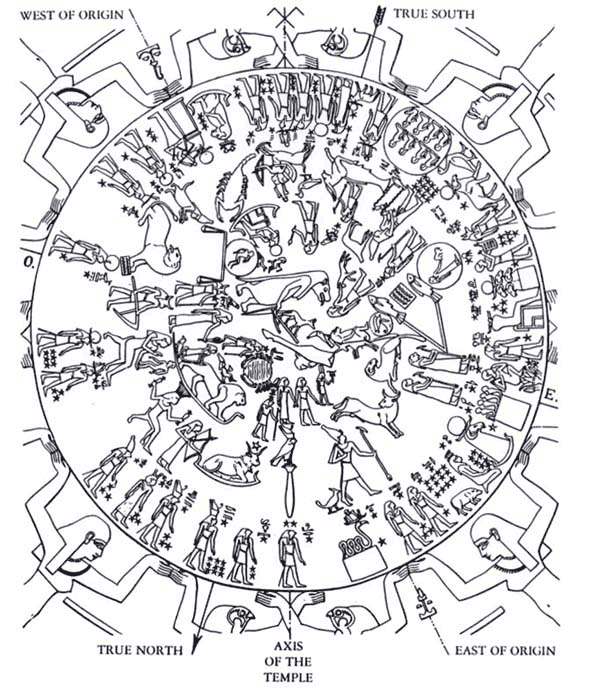
Drawing by R.A. Schwaller de Lubicz, The Circular Zodiac of Dendera, showing the single thigh at center