



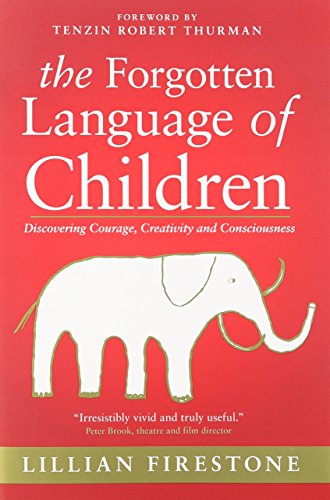
Discovering Courage, Creativity, and Consciousness
By Lillian Firestone
Indications Press, 2010 • 301 pages
with two bibliographies, one for children, one for adults
When he appeared in the West in 1912, G. I. Gurdjieff brought knowledge gleaned from decades of search among the ancient and sometimes hidden spiritual traditions of the East. A circle gradually formed around him, including many of the prominent intellectuals and artists of the day who gave his ideas wider currency. These ideas had a perceptible influence in fields as diverse as physics, music, mathematics, theater and film. Gurdjieff’s view that man was not a finished being and that evolution of his consciousness is both attainable and necessary inspired and modeled the human potential movement of the 1960s.
Gurdjieff’s Unconditional Respect for Children’s Inner Lives
Children were particularly important to Gurdjieff. Most striking was his unconditional respect for their inner lives and their forgotten language. Gurdjieff was a linguist, a master communicator. The forgotten language of children is perhaps his native essence tongue. Perhaps our elemental native tongue, forgotten by most as are our out-grown pajamas. Potentially as subtle, and nuanced as is genuine empathy. Firestone’s book reflects a sincere wish to escape daily life’s inertia and experience who the children were and who they could become—Yet how to nourish the wish to relate to this inner language? How to communicate, listen, hear essence speak?
This was the challenge facing Lillian Firestone and a small group of adults—all members of a Gurdjieff group in New York City in the early 1960’s. This Children’s Team became the focus of Firestone’s life for the next twenty years. The challenge was to bring children a spiritual experience of life without indoctrinating them into a particular teaching.
The Children’s Team Guiding Principles
As instructed by Jeanne de Salzmann, Gurdjieff’s direct and longtime student, and his spiritual heir, the children’s team were to “Encourage the children to think for themselves, and not to be afraid.”
The Children’s Team developed guiding principles and themes based on the children’s age. For children from seven to ten one of the Work day themes was “We come here to be stronger. When I feel like stopping, can I go on?”
While one theme for children ten to thirteen was “The job needs doing. How is my work when I do a job I like? How is it when I do something I don’t like? Do I let my likes or dislikes get in the way?” This nuanced direction and redirection provides an opening, an opportunity for the children to consider their actions impact on others on their Work day team and themselves.
Reflecting on his years in the children’s work, Chris, a former participant recalled that, “While in the children’s work, I learned how to hammer a nail, plaster a wall, saw, plumb, drill, listen, sit quietly, watch, hear, see…that I had something to say, that there were many different sides to me, that it rains out of nowhere in Arizona, that the mountains in Montana have to be one of the most beautiful sights on earth, that I didn’t know America until I’d seen it—and the same goes for myself.”
Gurdjieff tells us, “If you wish your children well, you must first wish yourself well. For if you change, your children, too, will change.”
Firestone’s years in the Work began when she was twenty-five. A new mother raising a daughter alone in New York City, she recalls “Everything I had counted on had crumbled.” She confided in a college friend that she had decided to go to India, find a spiritual teacher. Unexpectedly, the friend tells her it isn’t necessary to go to India. She asks Lillian if she has heard of the Gurdjieff Work. The friend gives her a copy of In Search of the Miraculous and a phone number. A month later her telephone call is returned.
Firestone writes that she heard herself tell Evelyn Sutta, the woman who returned her call, that “My life is like a car rolling downhill, and I can’t find the brakes. Sutta replies, “In the Gurdjieff Work the conditions in which you find yourself are the best place to start.”
So it was with The Children’s Team. Based on Gurdjieff’s ideas, with the aim of creating conditions for the children to practice navigating life competently and with courage while remaining in touch with their essential nature, their native tongue.
Lord Pentland and the Art of Asha
One Work week, Lord Pentland, the President of the Gurdjieff Foundation in the United States, visited the children and read them a poem by the tenth century poet, Firdusi, who explained the game of chess. The young people spent weeks discussing the poem and playing chess. Encouraged by the group leaders they wrote and produced a play called “The Art of Asha.” A giant chess board was painted on the stage floor. Each chess piece was represented by a costumed child. Two other young people were in the role of the young Persian Prince and his tutor who were to play the game with these living pieces.
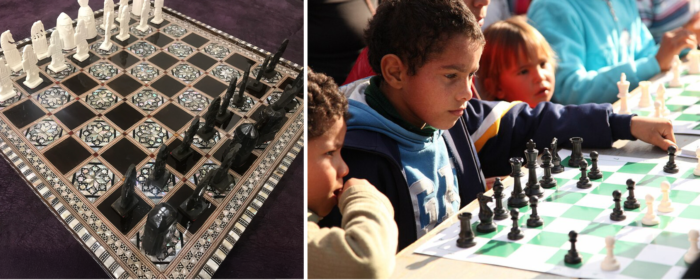
The night of the performance twenty-five excited young people awaited their turn on the chess board. Suddenly, Alice, the black queen, turned to Firestone and said, “I can’t do it. I forget.” Her important role cued many other speeches. Quietly, Firestone said to the fourteen-year-old with theatrical aspirations beyond the chess board, “The audience is not coming to see you, they are coming to see your work.” Firestone recalls, “With relief she remembered that people would not judge her personally, and her lines returned to her.”
Both a memoir and call to action, this book is an essential contribution to the Fourth Way canon. Filled with unique, previously unpublished accounts of the teams’ Work and travel with the young people, may leave some parents today gasping at the ambitious road trips undertaken.
On the Road Less Taken
Between 1963 and 1978 the team of adults and children planned, plotted, and made eight cross-country trips ranging from Canada’s Maritime Provinces to Arizona’s pueblos.
A young woman, Susan, had joined the Children’s Team in the early 1970s. With a Ph.D. in Native American studies, she suggested a road trip to the Onondaga Reservation a few hundred miles away from New York City. A traditional Native American community within driving distance was an exciting new idea, Firestone writes. “We decided to prepare ourselves and the children by learning some of the Mohawk language and then travel together to their reservation.”
“Contact will be difficult,” Susan cautioned, explaining that the Indians were not eager to be entertainment for tourists; in fact the reservation was closed to uninvited guests. Firestone writes, “Still we were hopeful.”
Indian legends, myths about the ages of the earth, trickster stories and tales were read to the children. “We read Apologies to the Iroquois. We learned how traditional Indians reached agreement through long silent meetings of the whole tribe, and of their respect for a universal spirit that infused all creation with life. Here were people who integrated the sacred into the everyday.”
Susan found out that a powwow, a general assembly, would be held in July at Onondaga where all tribes would be welcomed and visitors tolerated. Nineteen children signed on, ranging in age from Susan’s two-year-old to young teenagers.
Firestone wanted to find “a worthwhile destination” for the children’s holiday, one which offered new meaning.” The adults and children attended the powwow where Firestone meets Henry, a Micmac from a reservation in Nova Scotia. She writes, “He related his stories of white man’s betrayal with remarkable impartiality, without reproach.”
When Henry invites them all to the Canadian reservation they agree to come for ten days. This will be the worthwhile destination. Arriving at the reservation, Henry led them to his mother’s house. His mother shows Firestone a valuable lesson when she persuades her to let a small boy sleep later than the other children. “He’s still little,” she said smiling at me kindly to show that she wasn’t challenging me, that she meant no harm… Henry’s mother had given me a gift, to see things as they are; a tired child doesn’t need to be woken up for a breakfast he won’t be able to eat. The Indian way is about living with the reality of what is.”
However, this reality was at a perceived cross purpose with Firestone’s tribe. The men were uneasy with the lack of a program, the lack of a daily schedule with timed activities. That night a musician played what was described as “traditional Indian music”. The music was traditional Irish and English folk tunes. The children were happy; the adult teams leaders were not. “This is not the Children’s Work,” one man said.
That begs the question: How could people in the Work hurl the Indians’ hospitality back in their faces? Apparently the team leaders learned nothing from their studies of traditional people reaching agreement through “long silent meetings.” After a long night of back and forth, a majority of the adult team leaders vote to conclude the visit to the reservation. The children noted the hurt expression on Henry’s face at their hasty departure. Firestone recounts—
In our contact with traditional people, like the many white people before us, we had broken our promises as soon as they no longer suited us.
“Encourage the children to think for themselves,” Jeanne de Salzmann had told us. I could not even think for myself. I had always looked for someone else to guide me, and now it was clear that to find the way, I must go deeper inside and trust that voice that called me to the more difficult alternative.
“Encourage them not to be afraid,” Madame de Salzmann had said.
But fear had ruled me; fear of being in the wrong, of losing the approval of the team. How could I model fearlessness when I buckled under fear?
Mitigating Remorse?
How to mitigate the remorse Firestone experienced? She writes that
Remorse of conscience for one’s past deeds against one’s own convictions became a reality for me. This experience became my guide. I cannot give my conscience over to anyone, not even “my” team.
Does this experiencing point to what Mr. Gurdjieff tells us of justice?
You know “Justice” is a big word—it is a big thing in the world. Objective things are not small things like microbes; they go according to law, as the law has accustomed them to go. Remember: as you sow, so you shall reap.
Not only people reap, but also families and nations. It often happens that that which happens on earth comes from something which was done by a father or a grandfather. The results converge on you, the son or grandson; it is you who have to regulate them. This is not an injustice, it is a very great honor for you; it will be a means which will allow you to regulate the past of your father, of your grandfather, great-grandfather. If misfortune comes to you in your youth, it means that someone brought them—for this you must reap. He is dead; it is another on earth who reaps. You must not look at yourself egotistically. You are a link in the chain of your blood. Be proud of it, it is an honor to be this link. The more you are obliged to repair the past, the more you will have remorse of conscience. You will succeed in remembering all that which you have not done in the past. Those things which you have done contrary to justice have mortified your grandfather. Thus you can have ten times more remorse of conscience and your worth will augment in proportion.
Firestone digs deep, questioning her behavior—is it operating in alignment with her values? Values she is working to model for the children. Questioning anew Henry’s explanation of how his ancestors reasoned that the settlers, in order to say one thing and do another —“the Europeans must have two hearts in their chests.”
Duplicity? Or a manifestation of our multiplicity of selves, of “I”s? As Mr. Gurdjieff tells us does not one “I” make a purchase and another “I” pays the bill?
The depth of attention, laser-like, the need for impartial love and if that was too much, impartial attention. Firestone writes —
We could turn our gaze on the children with enough awareness to see them, not just a projection of our idea of them. We could make an effort to hear the child through the screen of language, listening for the meaning behind their words.
Perhaps finely tuned to the forgotten language of attention, of love, we may hear the “forgotten language of children” sounding within. 
—Anny Cleven
Regarding children, how to relate to tender essence?
What quality of effort, attention, is required to nurture the being becoming?
Notes
All quotes are from The Forgotten Language of Children, Discovering Courage, Creativity, and Consciousness.- Encourage the children. iii.
- “If you wish your children well.” iii. Original source: G. I. Gurdjieff, Views From the Real World: Early Talks as Recollected by His Pupils (London: Routledge & Kegan Paul, 1975).
- For children from seven to ten, one of the Work day themes. 235.
- One theme for children ten to thirteen was the job needs doing. 236.
- Reflecting on his years in the children’s work. 97
- Everything I had counted on had crumbled. 23.
- My life is like a car rolling. 23.
- We decided to prepare ourselves. 175.
- We read Apologies to the Iroquois. 175.
- He related his stories.182.
- He’s still little. 82.
- In our contact. 198.
- Remorse of conscience. 199.
- “You know ‘Justice’ is a big word.” 206. Original source: Voices in the Dark: Esoteric, Occult & Secular Voices in Nazi-Occupied Paris 1940–44, by William Patrick Patterson (Fairfax, CA: Arete Communications, 2000), 174–75.